


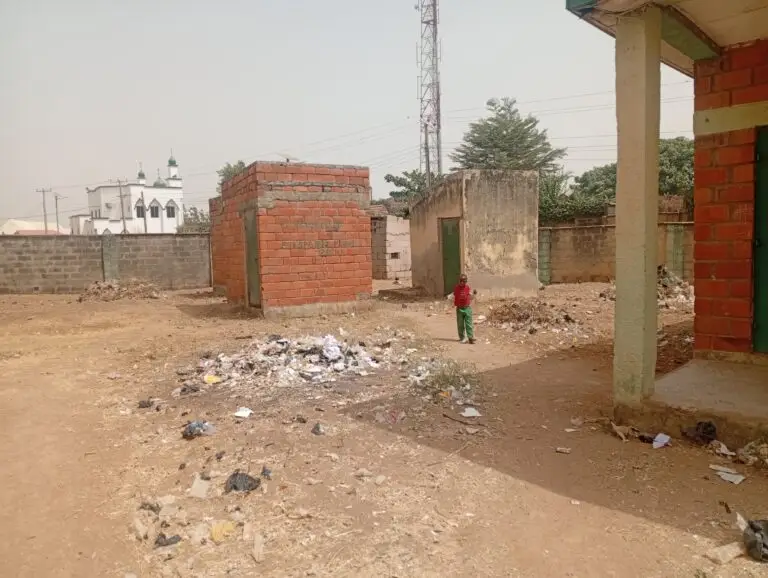
Girls of Jalo Model Primary School in Rigachikun, Kaduna State, have raised concerns over the inadequate Water, Sanitation and Hygiene (WASH) facilities in their school, saying it affects their learning.
The students stated that the lack of proper toilets and clean water makes it difficult for them to concentrate in class and maintain personal hygiene, particularly during school hours.
The girls, mostly in Basic Nine, made the disclosure during a school visit by the Education as a Vaccine (EVA) team to empower girls to speak on challenges affecting their education in the state.
Khadija Muhammad stated that education was important for girls and should be supported by providing adequate WASH facilities and learning materials to help them thrive.
“We don’t have water in the school and the toilets are very dirty and inadequate; the boys usually ease themselves outside the toilet messing up the school environment.
“As for us, we go to neighboring houses to ease our selves because we need water to wash ourself afterwards,”she said.
Amaturrahman Ahmad, who wants to become a Medical Doctor in the future said she was happy that her parents allowed her to go school so that she can be educated unlike other girls in her community who didn’t have the opportunity.
She explained that lack of water and inadequate toilet was affecting her learning, urging the state government to provide WASH facilities and employ cleaners that would take care of the facility.
Another pupil, Hauwa’u Yahya, explained other challenges pupils faced in school such as lack of desks, doors, and writing board.
According to her, teachers come to class as they should and teach to the best of their ability, but due to the over population in the classrooms, not everyone understands what was taught.
She urged, “We are about 150 students in one class; I am calling on the government to come to our school, see the situation we are in, and help us by providing more classrooms, more doors, and more windows.
” We also do not have drinking water, so they should help us by providing a borehole so we can have water to drink”,she said.
Speaking earlier,the EVA representative,Ms Mercy Abalaku said the initiative, “Fostering Accountability for Girls’ Education“, links girls with decision-makers and accountability groups to share experiences and advocate solutions.
She said the project was informed by findings from a 2020–2023 advocacy programme which identified persistent barriers such as inadequate infrastructure, gender-based violence, sexual and reproductive health concerns and poor WASH facilities in schools.
Abalaku added that although education receives high budget allocations in the state, often above the benchmark of UNESCO, gaps in facilities still exist.
According to her, the three-year intervention is being implemented in selected Local Government Areas in collaboration with the Kaduna State Ministry of Education, with plans to strengthen community accountability structures to sustain advocacy beyond the project period.
Meanwhile, the Head of primary six of the school ,Mr Zakari Isah described the initiative as timely, saying that the girls required guidance and advocacy due to challenges they face at a young age.
Isah, however, highlighted infrastructure deficits in the school, including lack of electricity, inadequate water supply and poor sanitation facilities.
He said although the school’s borehole was functional, water cannot be pumped due to the dearth of a generator, adding that theft had affected facilities, including equipment in the computer room.
Isah called on the government to prioritise security as well ad address electricity and sanitation challenges to improve the learning environment.
(NAN)