


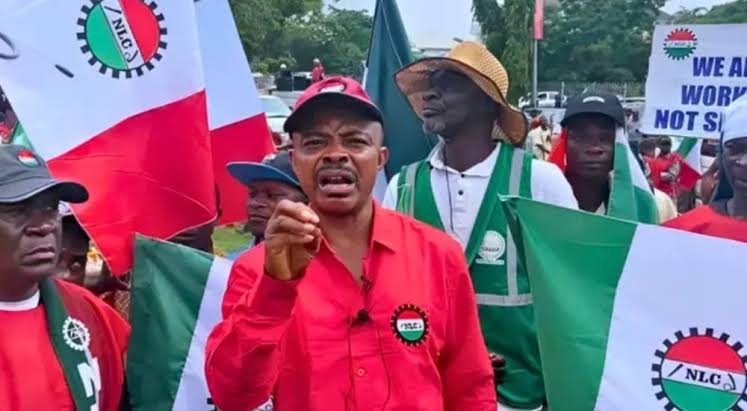
The Nigeria Labour Congress (NLC) yesterday demanded a cost-of-living allowance, a wage award for workers and tax relief to cushion the effects of the recent increase in the price of fuel occasioned by the ongoing crisis in the Middle East.
The NLC, in a statement titled ‘Save Nigerians From This Shock: An Urgent Relief Has Become Necessary,’ signed by its president, Joe Ajaero, also called for immediate steps to revive Nigeria’s refineries.
It said the petrol price hike had worsened the economic hardship facing Nigerian workers and citizens.
It said the federal government cannot foreclose any action that would offer relief to the people.
According to the NLC, it is the duty of the state to act decisively to prevent the suffering of its citizens, “rather than helplessly attributing the crisis solely to the Middle East conflict.”
The NLC’s demands came two days after the Nigeria Press Organisation (NPO) sought President Bola Ahmed Tinubu’s intervention of import tariffs on newsprint and broadcast equipment.
The NPO sought the intervention on Friday when the president hosted the leadership of the Nigeria media at the Presidential Villa, Abuja.
The government had, last week, said it was closely monitoring the escalating tensions in the Middle East and remained committed to safeguarding Nigeria’s economic stability.
The Nigeria Economic Summit Group (NESG) had said the escalation of tensions between the United States/Israel and Iran had triggered the most significant global energy shock since the Russia–Ukraine war, arguing that Nigeria can convert the crisis into an opportunity to strengthen macroeconomic stability if policymakers respond with discipline.
Our demands – NLC
The NLC listed its demands as including immediate wage award and cost-of-living allowance (COLA) for all workers to cushion the rising cost of living; expansion and overhaul of the Cash Transfer programme to ensure transparency and guarantee that assistance reaches the most vulnerable citizens, with transfers adjusted to reflect inflation; immediate tax relief for workers, including suspending regressive taxes on low-income earners and taxing the informal sector.
Noting that taxing minimum-wage earners amounts to extortion, the NLC also demanded a clear timeline for the full operationalization of all public refineries.
It said the Nigerian state must be held accountable for the billions of naira spent on turnaround maintenance.
It accused the government of leaving Nigerians at the mercy of volatile global oil prices triggered by the esc+alating Middle East crisis, alleging that the situation had exposed the fragility of Nigeria’s downstream petroleum sector and deepened the suffering of workers and their families.
“NLC voices the collective anguish of millions of Nigerian workers who are bearing the brutal cost of a global capitalist crisis they did not create. The military escalation involving the United States, Israel, and Iran has sent shock waves through global oil markets. As a result, petrol prices in Nigeria have skyrocketed to between N1,170 and N1,300 per litre.
“This is a direct assault on the Nigerian people. While imperialist rivalries play out abroad with bombs and military escalation, Nigeria’s working class is being bombarded with poverty and hunger because we have failed to ensure that our public refineries are operational.
“This crisis has brutally exposed the fragility of Nigeria’s downstream petroleum sector. It has stripped away the illusion that local refining alone would shield the country from global shocks. The Dangote Refinery has adjusted its prices in line with global volatility, passing the burden directly to the masses. This undermines the narrative that domestic production alone guarantees price stability.
“As long as Nigeria remains dependent on a market-driven pricing structure tied to global fluctuations, and refuses to revive its public refining capacity, the country will remain hostage to international conflicts and market speculation.
“The NLC had earlier warned about the danger of sabotaging public refineries in ways that could create monopolistic control in the downstream sector. This moment must serve as a wake-up call to the managers of Nigeria’s economy.
“No nation achieves economic independence by exporting jobs and importing prices. The government must immediately halt the decay of the public sector and ensure the full rehabilitation and operation of the Port Harcourt, Warri, and Kaduna refineries. This is not a favour but the right of the Nigerian people, enabling the country to cushion itself against an increasingly hostile global economic environment.
“The soaring cost of petrol, PMS, and diesel (AGO) has made transportation a heavy burden on workers. Food inflation continues to rise, while meagre wages are being swallowed by the rising cost of living. When workers cannot afford transportation to their workplaces, the economy stalls. When families cannot afford three meals a day, society sits on a keg of gunpowder.
“Recent projections by the Nigeria Economic Summit Group (NESG) indicate that Nigeria may gain an estimated N30 trillion oil windfall from the ongoing Middle East crisis.
“Nigerian workers are being pauperized and subjected to immense suffering. Workers are not statistics—they are the engine of the nation. When the engine overheats, the entire vehicle crashes.
“The estimated N30 trillion oil windfall expected from the Middle East crisis must not disappear like previous windfalls. These resources must be invested in the Nigerian people and used to cushion the economic hardship caused by the current crisis.
“The government must engage in sincere social dialogue with Nigerian workers and the broader citizenry. Using the Middle East crisis as a justification for policies that deepen poverty is unacceptable. The primary duty of the government is to ensure the welfare and security of its citizens. We demand action. We demand justice. We demand survival.”
Oil marketers count losses
Meanwhile, 16 days after the outbreak of US-Israel war with Iran which has reverberated across the Middle East, Nigeria’s downstream petroleum sector is grappling with unprecedented volatility as marketers struggle to cope with rapidly fluctuating fuel prices.
The conflict has had immediate consequences for global oil supply chains. Fears that the Strait of Hormuz—one of the world’s most strategic oil shipping routes—could be disrupted pushed crude oil prices sharply upward in the early days of the conflict.
As global crude benchmarks climbed above $100 per barrel, fuel markets across the world responded with swift price increases, with countries heavily dependent on imported refined products feeling the effects most acutely.
Nigeria, despite being Africa’s largest crude oil producer, remains exposed to these global price movements because domestic fuel pricing now reflects international crude benchmarks.
Consequently, the surge in crude prices quickly translated into higher ex-depot prices and retail pump adjustments nationwide.
At the centre of the pricing turbulence is the Dangote Petroleum Refinery which has emerged as the dominant supplier of petrol in Nigeria’s deregulated fuel market.
At the moment, the refinery which many see as a life-saviour for Nigeria in the midst of the current global turbulence triggered by the hostilities in the Middle East, supplies over 90 per cent of the local demand as the latest data from the Nigerian Midstream, Downstream Petroleum Regulatory Authority (NMDPRA) indicated.
Within just two weeks of the Iran conflict, the refinery adjusted its petrol gantry price multiple times in response to global crude fluctuations.
Available market data showed that the refinery reviewed its price structure at least five times within the period, reflecting the volatility in international oil prices.
On March 2, Dangote raised the ex-depot price of petrol from N774 per litre to N874 per litre, citing rising crude oil prices and increasing replacement costs.
Days later, the refinery again reviewed the price upward, raising the gantry price to N995 per litre, representing a jump of about N221 within four days.
As global crude continued its rally, the refinery implemented another upward revision, raising the price to N1,175 per litre, marking the fourth adjustment since March 2.
However, when crude oil prices briefly retreated following diplomatic signals suggesting a possible de-escalation of the conflict, the refinery reversed course.
It subsequently reduced the gantry price by N100 to N1,075 per litre, reflecting the fall in crude prices from around $110 to about $88 per barrel.
But with crude prices surging again, the refinery has reinstated the N100 reduction, returning its gantry price to N1,175 per litre.
These rapid revisions have effectively reset pricing benchmarks across Nigeria’s downstream petroleum market, forcing marketers and depot operators to constantly recalibrate their sales prices.
As of the time of filing this report yesterday, Brent Crude was $103.1 per barrel as the market shows no sign of retreat with the tensions in the Middle East still raging.
Many independent marketers who purchased products at earlier prices suddenly found themselves selling at a loss after new price templates were introduced.
A depot operator in Lagos explained that the market has been operating almost on a daily price-discovery basis since the war began.
“Some marketers bought petrol at close to N1,175 per litre, but before they could sell off their stock, the refinery adjusted prices again. That immediately wiped out their margins,” the operator who spoke in confidence said.
Speaking to Daily Trust yesterday, a former chairman of the Independent Petroleum Marketers Association of Nigeria (IPMAN), Akinrinade Akinade, said the volatility had effectively transformed fuel trading into a high-risk activity, where price swings within days could determine whether marketers record profits or losses.
According to him, the situation has forced many marketers to adopt cautious buying strategies, purchasing smaller volumes of fuel to avoid exposure to sudden price changes in order to remain in business.
The national president of the Petroleum Products Retail Outlets Owners Association of Nigeria (PETROAN), Dr Billy Gillis-Harry said there is no end in sight yet to the price fluctuation. He insisted that the projection by PETROAN that the price of PMS would hit N2,000 per litre would come to pass with the war still raging.
He said, “So long as this war is raging in the Middle East, we will continue to have this fluctuation because the price of crude oil will continue to go high. The price of crude oil came down just a few dollars and then it went up high again because the war is premised on body language of the President of America and his speeches.
“So if he wakes up and just says something, before you know it, the whole thing has just collapsed into a different thing. So for us, we are only buying products from Dangote now. Maybe the government may consider some other options, but where will you even import from?”
He called on the federal government to set up the domestic energy bank to provide capital for energy related businesses.
He added, “Banks are not available to give us loans, and that’s why we have requested the government to set up a domestic energy bank that can take care of all the energy sources that are needed.”
The National Publicity Secretary of IPMAN, Chinedu Ukadike, said the independent marketers were fed up with the price volatility and what he called, “the inconsistency” in the pricing template.
“This has become a risky situation because we are businessmen and we must continue to do business. We cannot go out of business. So it is a gain and loss situation. Because of that instability, marketers cannot say whether they have gained or lost.
“Because of the essential nature of the business, we would continue to provide petroleum products no matter the kind of fluctuation and market dynamics we are experiencing. We will continue to ensure that we make petroleum products available knowing fully well our position and the direct effect it will have if we decide not to supply.”
A professor of Petroleum Economics, Wumi Iledare, in an interview with Daily Trust, said: “What we are seeing is the practical reality of a deregulated downstream market in Nigeria. There are no longer guaranteed margins, and price volatility — influenced by global tensions, exchange rate movements, and domestic supply shifts — is now the new normal.
“For marketers, survival will depend on stronger risk management, tighter cost control, and smarter inventory decisions. They also need to explore collaboration and strategic alliances to improve their bargaining power in an increasingly concentrated wholesale market.
“This is a transition period. Those who adapt quickly to market-driven pricing, improve operational efficiency, and reposition their business models for competition rather than protection will be better placed to remain viable in the evolving downstream landscape.”
Daily Trust