


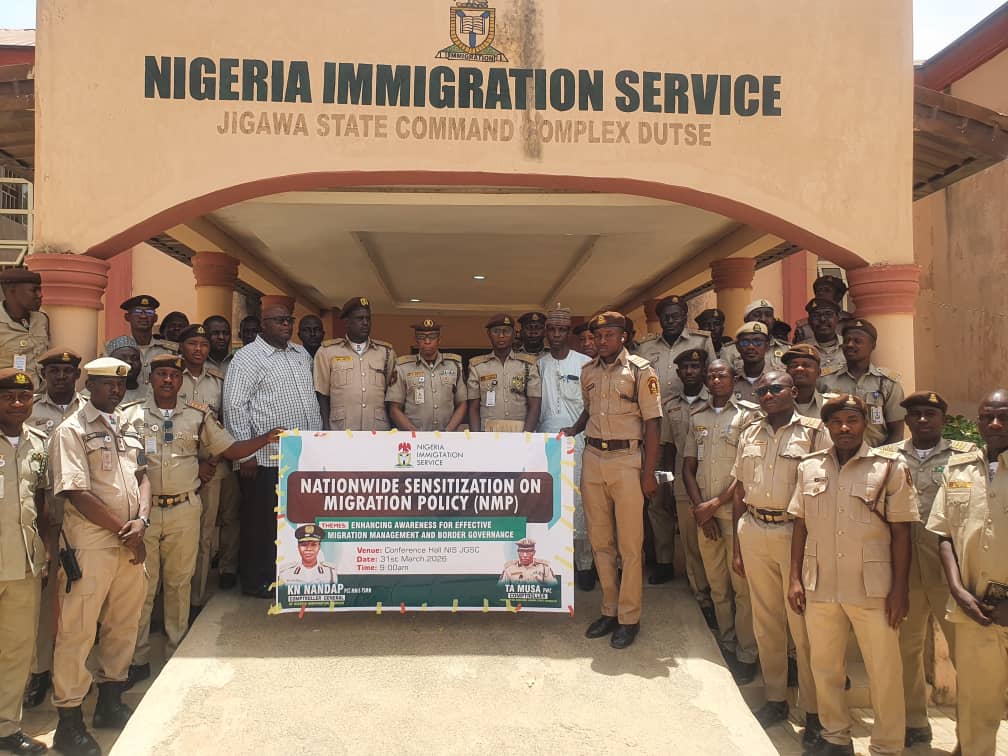
Kemi Nandep, the Controller-General (CG) of the Nigeria Immigration Service (NIS), says the service must remain committed to building a migration system that’s secure, efficient and humane.
Nandep, represented Mr Tahir Musa, the NIS Comptroller in Jigawa, made the remarks in her keynote address at nationwide sensitization on the National Migration Policy (NMP) 2025, themed :”Enhancing Awareness For Effective Migration Management and Border Governance”, in Dutse on Monday.
She explained in response to evolving migration dynamics, the service has actively engaged in high-level policy and strategic reforms aimed at strengthening migration governance and national security.
The CG added that these efforts have resulted in key initiatives such as the introduction of e-Visa regime, the contactless passport application system, the e-Border solution infrastructure, passport personalisation centre and launch of the Ecowas National Biometric Identity Card (ENBIC).
“At policy level, this has culminated in the validation of the National Migration Policy 2025, as migration remains a critical driver of national development, security and international cooperation.
“Global trends in migration and border governance, characterised by increasing complexity and rapid change, demand a coordinated and forward-looking migration frame work.
“Our borders serve the dual purpose of acting as the first line of defence against threats such trafficking in persons, smuggling of migrants, terrorism and other transnational crimes, while also functioning as vital gateways for legitimate trade, investment and tourism,” The GC said.
This, she said underscores the imperative of maintaining s strategic balance between security and facilitation, anchored on sustained inter-agency collaboration.
According to her, the Nigeria’s NMP 2015 provided a foundational framework for safe, orderly and regular migration, supported by key institutional mechanism.
“The validated NMP 2025 builds on this foundation, addressing emerging realities, strengthening institutional coordinator and positioning Nigeria for more effective migration governance in line with global commitments, including the Sustainable Development Goals and the Global Compact for Migration (TCM).
“The NMP 2025 places emphasis on critical areas of border governance and migration management which are central to the mandates of the service,” the CG said.
She however, added that success of the policy will depend largely on its effective implementation, which requires the commitment, professionalism and adaptability of officers across all commands of the service.
Nandep, who described the sensitization as “strategic capacity building initiative”, urged the participants to actively engag, internalize the policy content and translate the knowledge gained into improved operational performance.
“Your understanding and application of the policy provisions are essential to achieving objectives. Therefore, we must remai committed to building a migration system that is secure, efficient, humane and aligns with national priorities,” she said.
The lecture provided detailed insights into the objectives, framework, and relevance of the National Migration Policy. It also addressed contemporary migration challenges and the role of NIS officers in ensuring proper migration management and national security.
The interactive session allowed attendees to ask questions and gain further clarification on migration-related issues.