


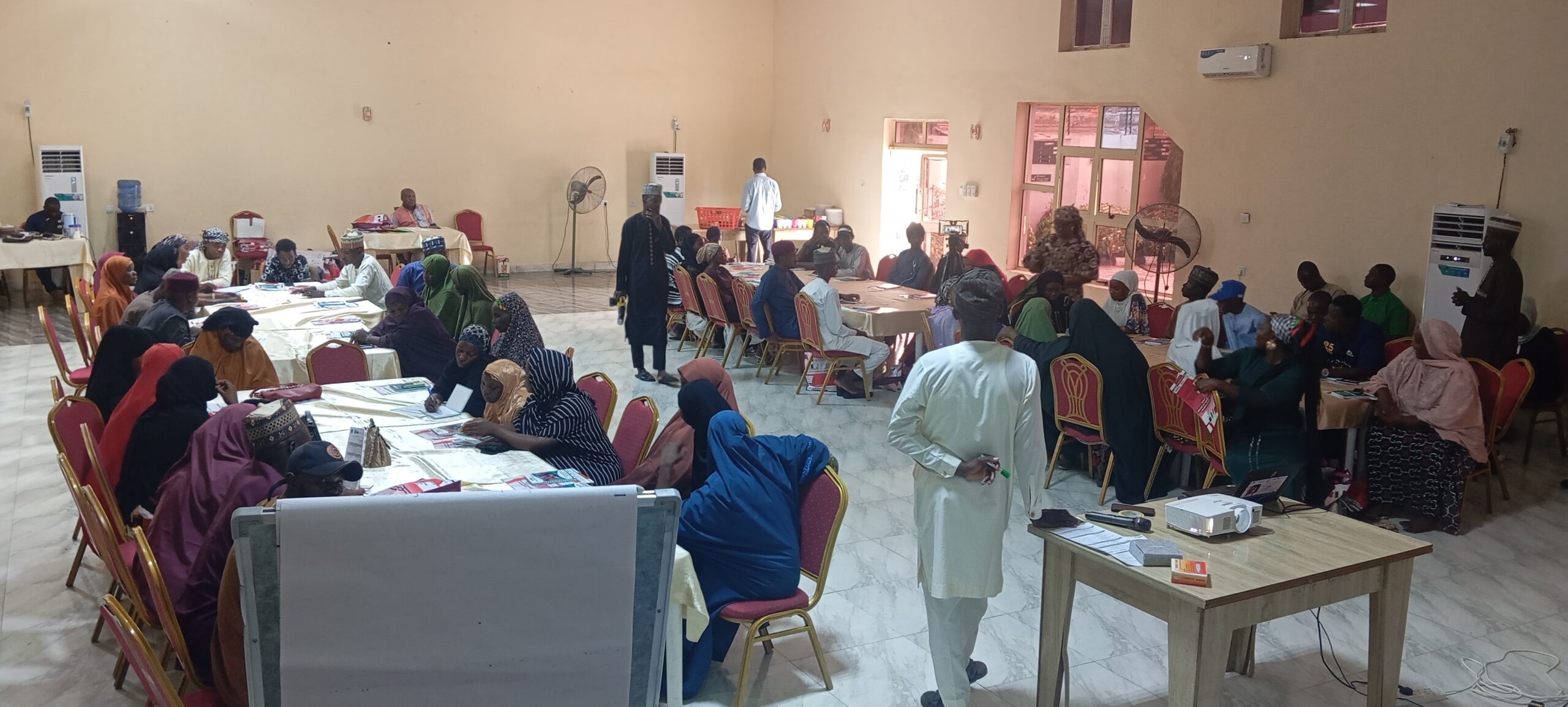
Participants at a four-day European Union (EU)-funded training organised by Mercy Corps in Katsina have pledged to apply acquired skills to prevent and resolve conflicts in their communities.
The training focused on Interest-Based Negotiation (IBN) and Community and Social Development Resource Management (CSDRM).
The training was implemented under the Conflict Prevention, Crisis Response and Resilience (CPCRR) Programme, in partnership with International Organisation for Migration (IOM) and the Centre for Democracy and Development (CDD).
Speaking on the impact of the training, Mr Shuaibu Junaidu from Dandume Local Government Area (LGA) said the exercise had broadened his understanding of conflict prevention and peaceful negotiation.
Junaidu said the knowledge acquired would enable him to engage community members more effectively and promote dialogue whenever disputes arose.
“I have learnt that conflicts can be prevented or resolved when people understand each other’s interests and work toward solutions that benefit everyone.
“I will take these lessons back to my community and use them to promote peaceful coexistence, especially among young people,” he said.
Similarly, Mr Umar Anas from Safana LGA said the training provided him with practical approaches to managing disagreements and preventing conflicts from escalating.
Anas said the exercise had strengthened his communication and negotiation skills, adding that he was now better equipped to engage different groups and encourage peaceful resolution of disputes.
He said the knowledge would be particularly useful in addressing conflicts involving youths, farmers and other community stakeholders.
Mrs Sa’adatu Hisaaini from Faskari LGA described the training as an opportunity for women to acquire skills that would enable them to play greater roles in peacebuilding and conflict prevention.
Hisaaini said women were often directly affected by conflicts but could also contribute significantly to resolving them when provided with the right knowledge and opportunities.
She expressed confidence that the skills acquired would enable her to support dialogue and peaceful resolution of disputes in her community.
Also speaking, Mr Mohammad Sani, Youth Development Officer, Ministry of Youth and Sports Development, said the training had enhanced participants’ understanding of conflict prevention, negotiation and responsible management of community resources.
Sani said the knowledge gained would help youth development officers and other stakeholders engage young people in constructive activities and promote peaceful coexistence.
He commended the organisers for bringing together participants from different communities and backgrounds, saying the engagement would strengthen collaboration and build trust among stakeholders.
Earlier, Mr Philip Ikita, the Mercy Corps Programme Manager, said the IBN component equipped participants with practical skills to promote dialogue, negotiation and peaceful resolution of disputes.
He added that the CSDRM component focused on sustainable and conflict-sensitive management of shared resources, including land, water and forests.
“The CPCRR Programme is designed to promote inclusive, locally-led and sustainable approaches to peacebuilding, conflict prevention, community resilience and socio-economic stability across Northwest Nigeria.
“The programme targets 48 communities in 10 LGAs of Zamfara and Katsina States, with Mercy Corps leading implementation activities in eight LGAs in Katsina,” he said.
According to him, the intervention builds on the successes of the Conflict Mitigation and Community Reconciliation (CMCR) project that seeks to address the root causes of conflict while strengthening community resilience and socio-economic recovery.
The training also provided participants with knowledge on resource mapping, conservation, climate-related conflicts and community collaboration.
It also brought together farmers, herders, women, youth representatives and persons with disabilities from Safana, Faskari, Sabuwa and Dandume LGAs.
Participants pledged to share the knowledge acquired with members of their communities and contribute to building stronger mechanisms for dialogue, peaceful coexistence and sustainable resource management.