


By Abbas Bamalli
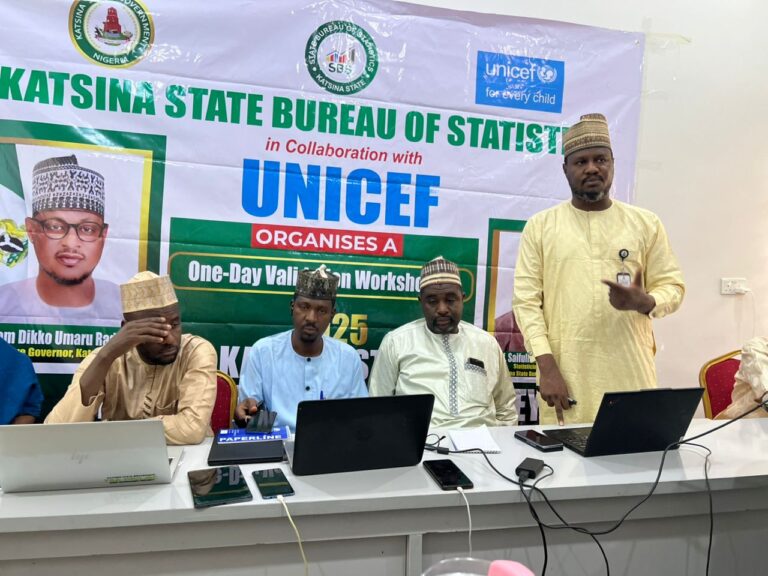
Katsina State Government, in partnership with UNICEF, has validated its General Household Survey (GHS) findings aimed to strengthen evidence-based governance, improve policy formulation and service delivery.
The State Commissioner for Budget and Economic Planning, Malik Anas, disclosed this at a one-day validation exercise in Katsina on Thursday.
Represented by the Acting Director Planning in the ministry, Abdulrahman Jibril, Anas described the engagement as a critical milestone in ensuring the credibility, accuracy, and reliability of data that would fast track development.
He noted that the validation process underscored the state government’s commitment to using verified and dependable data to drive socio-economic progress and enhance the wellbeing of citizens.
The commissioner commended Gov. Dikko Radda for his unwavering dedication to strengthening data systems and promoting informed decision-making.
According to him, the administration has continued to demonstrate strong leadership by supporting initiatives that advance development and improve living standards.
Anas also praised the State Statistician-General for his role in repositioning Katsina as a data-driven state, adding that the efforts had ensured the availability of reliable data for planning and governance.
The Commissioner further expressed appreciation to development partners, particularly UNICEF, for their sustained technical and financial support across key sectors in the state.
The validation exercise, he explained, provided stakeholders with the opportunity to critically review the survey findings, share insights, and ensure that the data accurately reflected the realities of households in Katsina communities.
Earlier, the Statistician-General, Prof. Saifullahi Sani, underscored the critical role of accurate and comprehensive data in addressing multi-dimensional deprivation and improving social interventions across the state.
He highlighted key indicators affecting children and households, including health, education, and economic conditions, stressing that reliable baseline data remained essential for effective planning and development.
He noted that the GHS, alongside internationally recognised metrics, provided a vital framework for understanding the realities on ground.
According to him, such data offers a holistic picture of the state’s socio-economic conditions and supports evidence-based decision-making.
He added that the state government had continued to prioritise the generation of multi-sectoral data with strong backing from the governor.
The Emergency Manager, UNICEF Nigeria, Dorica Tasuzgika-Phiri described the validation as more than a routine exercise, saying that “it is a defining moment for evidence-driven governance.”
Tasuzgika-Phiri stressed that credible, timely, and disaggregated data remained the backbone of meaningful development, especially for children and vulnerable communities.
She highlighted the pressing realities facing the state, from economic strain to insecurity and widespread deprivation among women and children, noting that such challenges demanded decisions firmly rooted in evidence.
According to her, the survey’s findings are not optional tools but essential guides that will help direct scarce resources to where they are needed most, ensuring that policies and interventions truly reach those at the margins.
For UNICEF, she added, the data serves as a powerful instrument for advocacy, planning, and tracking progress towards improved outcomes for children.
(NAN)